Excellence isn’t one thing. It’s two things, overlapping.
Mastery is developing real skill and making genuine progress in an activity.
Mattering is the deep sense that what you’re doing actually has significance, that your contributions and progress mean something.
Without mastery → it’s just a hobby.
Without mattering → it’s an empty grind, no matter how good you get at it.
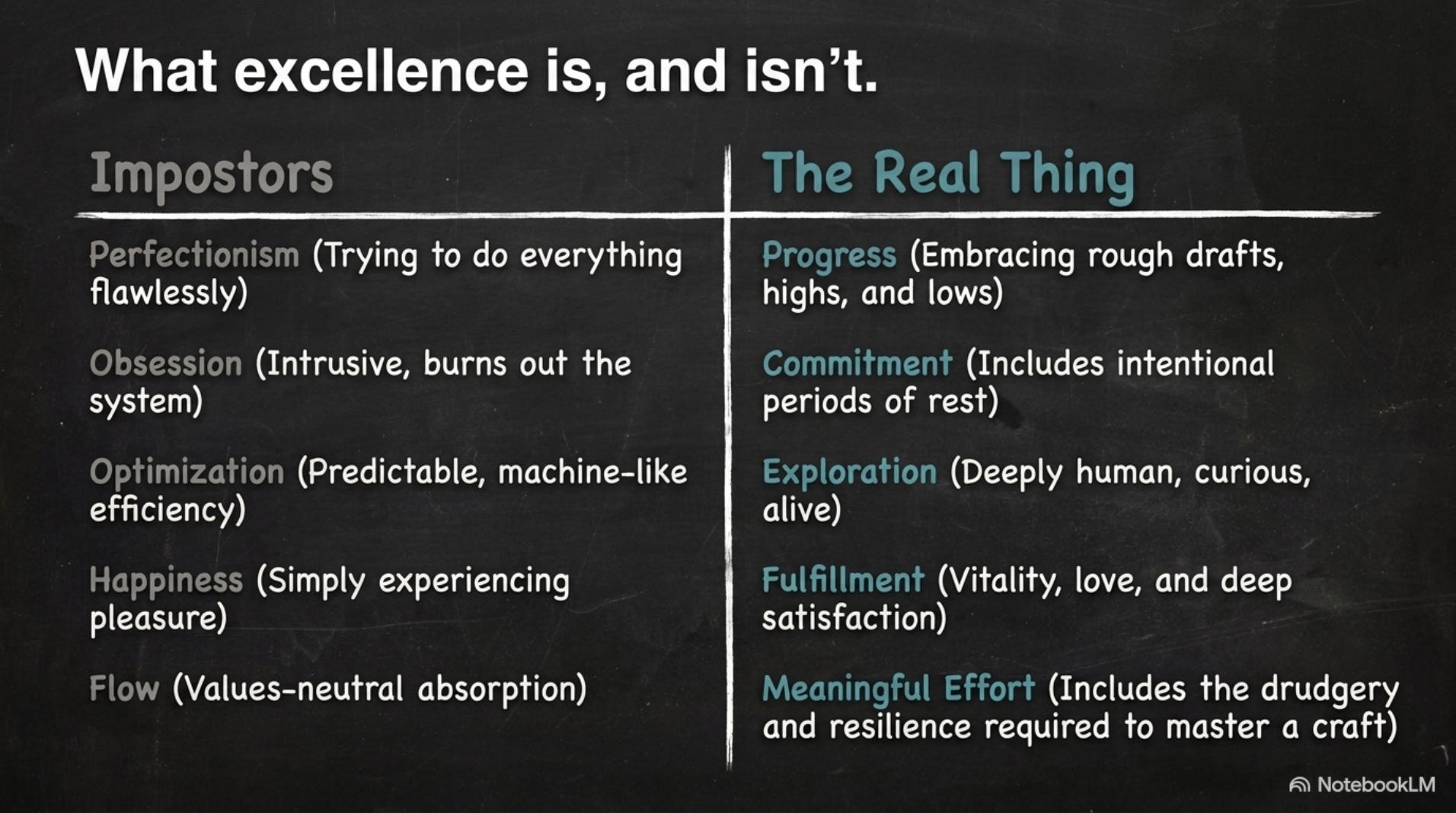
Excellence only exists at the intersection. Here’s where most people get it wrong. They chase things that look like excellence, and aren’t.
Discipline, defined
Discipline is the self-control gained by requiring that rules or orders be obeyed, and the ability to keep working at something difficult.
I’m not here to demonize discipline. It’s a genuinely important life skill.
It’s good to be able to grit your teeth and white-knuckle the wheel when you need to get something done.
It’s good to be able to control your impulses.
Discipline has its place. But it will not make you excellent. In fact, it’s often a sign that what you are doing is not in alignment with your values, or what you care about.
Let’s break down the formula that actually will.

T = Thing
First things first. How do we find the thing that we want to become excellent at?
It starts with caring.
Caring is the foundation that drives everything. Without it, all the knowledge and talent in the world isn’t enough.
Caring is a heartfelt concern, interest, and reverence for the pursuit. It’s the force that lets you give your best effort and stay consistent through the ups and downs.
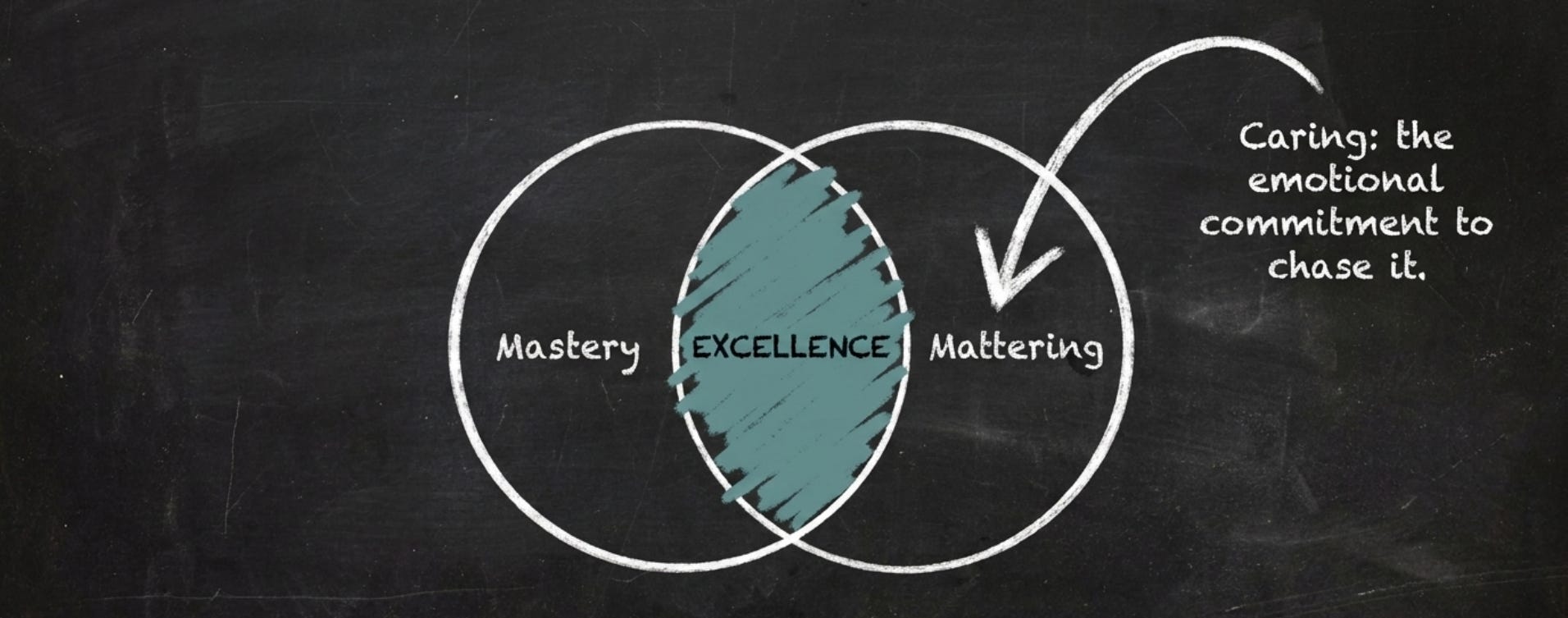
Remember mattering, the belief that a pursuit has objective value? Caring is the subjective, emotional commitment to actually go chase that value with intimacy and depth. Mattering and caring are a pair, not synonyms.
So how do you find what you care about? You lead with curiosity. Let me explain.
You can’t force someone to care about something. It has to be found.
Curiosity is the mechanism for that search. Think of it as a biological compass, letting you explore yourself and the world until you discover what you value. This is different from deciding on it from the outside and then trying to talk yourself into it.
There’s a reason Steve Jobs’ “connecting the dots” idea from his 2005 Stanford commencement speech gets quoted as often as it does. The core claim is that you can’t see in advance which pursuit is going to matter to you, only in hindsight. Trusting in that process is what lets you follow your curiosity off the well-worn path in the first place. Leading with curiosity permits you to experiment.
I didn’t always know what I cared about. I had to find it.
I enrolled in college as a sports management major, having set aside my real interest (videography) as a hobby, in favor of something that felt like the safer bet.
By the midterms of spring semester, freshman year, I knew I’d made the wrong call. The people around me loved what we were studying. I didn’t. I couldn’t force myself to care about it, and I could feel myself falling behind people putting in the same hours, with real interest behind them.
So I pivoted and leaned in hard to building a career in video production. It took three years, a lot of late nights, and a much larger volume of work, compared to completing my bachelor’s degree. But in a way, it was easy, because I wasn’t forcing myself to do something I didn’t want to do.
I cared about what I was doing. I felt that it mattered. I know this because when I was at work in this endeavor, the hours just slipped away. When time slips away like that, your antenna should go up. You may have stumbled onto something you actually care about.
R = Routine
Once you know your Thing, you need a system for pursuing it. Without one, you’ll have to rely on your discipline, and eventually you will burn out.
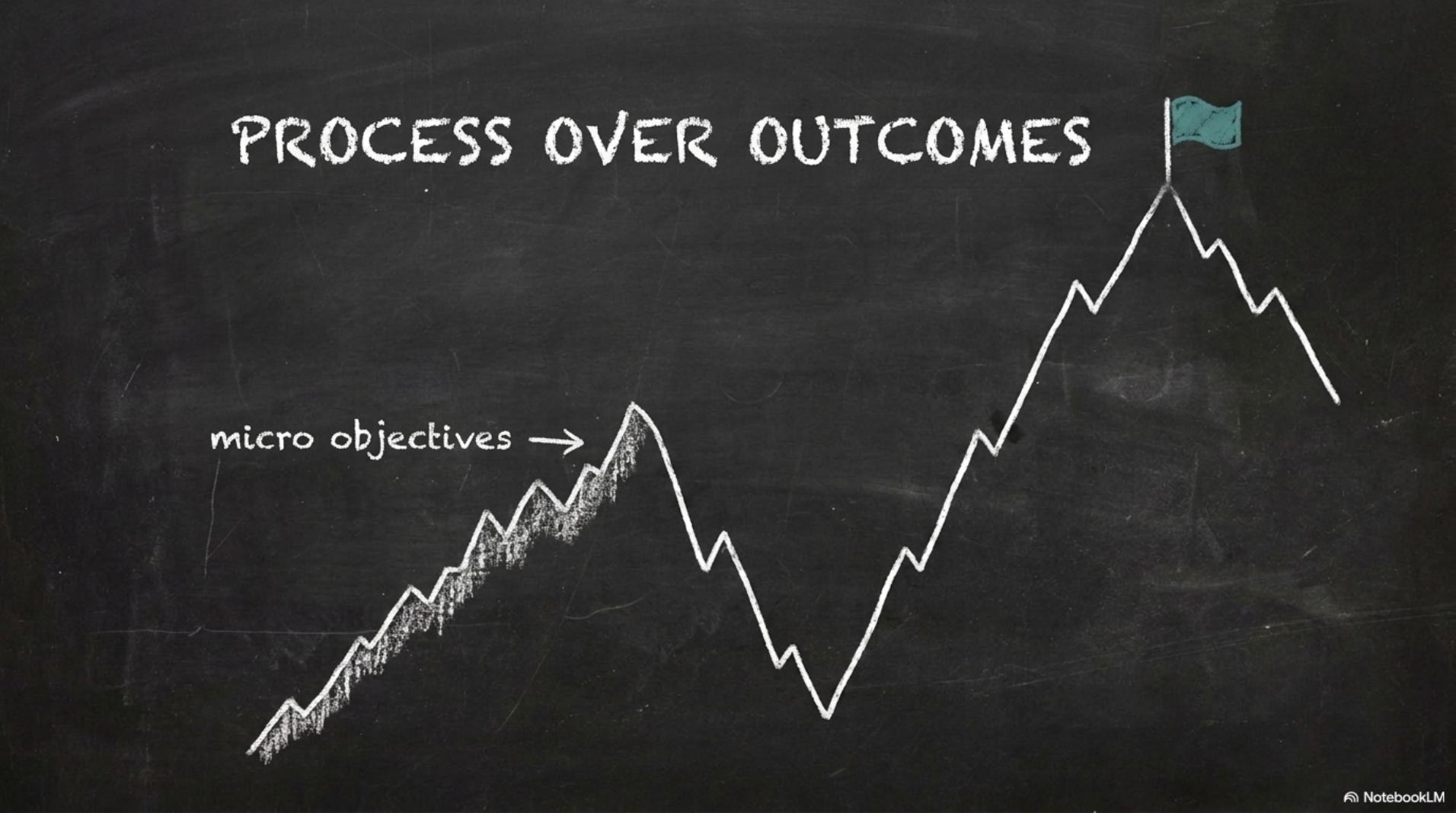
A great system is a routine built around process, not outcomes. A process-over-outcomes mindset is the shift from obsessing over the destination, or the summit, to focusing entirely on the immediate journey, or the sides of the mountain.
Goals still matter, obviously, as they give you direction. But nearly all of the actual growth and lived experience happens during the pursuit, not at the point of arrival.
The summit just gives the sides their shape.
Here’s what a routine actually does for you: it automates decisions. Once something is part of your routine, you don’t have to choose to do it anymore; you just do it, without thinking. This removes the need for… discipline. You’re not gritting your teeth and debating whether to take action, every day. The choice already got made, a long time ago.
On the sides of that mountain are smaller micro-objectives, which are smaller milestones on your path to reaching your goal. These give texture to the journey, and you should celebrate them, no matter how small. Accomplishing these micro-objectives releases dopamine, the neurochemical tied to fulfillment. This will refuel you, and sustain you on your journey for years, or even decades.
“A man on a thousand mile walk has to forget his goal and say to himself every morning, ‘Today I’m going to cover twenty-five miles and then rest up and sleep.”
― Leo Tolstoy, War and Peace
It also protects you from the arrival fallacy; the false belief that reaching the goal itself is what delivers the fulfillment you desperately crave.
“There’s no greater illusion than thinking that the accomplishment of some goal is going to change your life. What will change your life is who you become in the process of going for it.” - Brad Stulberg
S = Support
Nobody does this alone, not sustainably, anyway.
Why do we run simulations in engineering and science? It’s because testing every possible outcome yourself in the real world is slow, expensive, and sometimes dangerous. A simulation lets you learn from an outcome without having to experience it firsthand.

That’s exactly what a community does for you. Pursue something by yourself, and you only get to learn from your own trial and error. But if you surround yourself with people on a similar path, suddenly you have access to everyone else’s journey too. You can learn from their mistakes and discoveries without having to personally experience every one of them yourself. A rising tide lifts all boats.
D = Decade
Look at the equation again. Decade isn’t added to Thing, Routine, and Support, it’s the exponent. Time multiplies everything.
Excellence requires exponential growth; linear growth would be too slow. What this means is that you can’t make the same mistakes over and over again. You have to foster a habit of learning and continuous improvement, even if that improvement is really small.
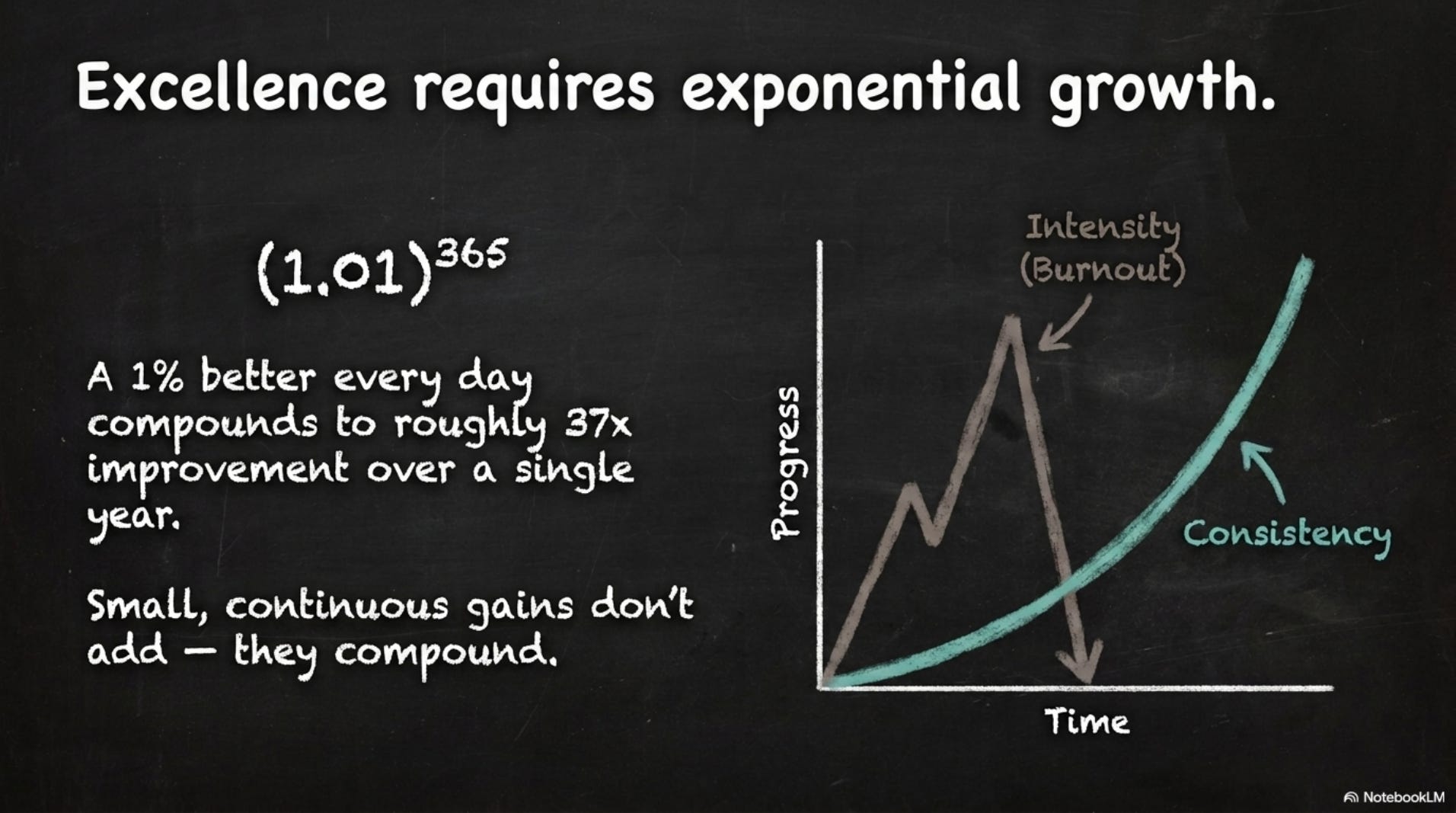
Small, continuous gains compound with time, and after a long time, they make a huge difference. Routine is essential to us making consistent deposits into this journey.
Okay, but how is this different from discipline?
Discipline requires willpower, and willpower is a finite resource. A routine requires almost no willpower. It’s a system. It’s written down. You just do it. You don’t have to expend energy thinking about how to do it.
Don’t Take A Zero
Nothing destroys a long-term average faster than a zero. Adjusting your expectations to match your capacity on difficult days keeps the ball in play and lets your efforts keep compounding. In a sense, what you do on your bad days is actually far more important than what you do on your good days. Don’t take a zero!
Pound The Stone
Pounding the stone represents the rugged consistency of showing up and putting in effort even when breakthroughs aren’t visible. “Overnight” breakthroughs are actually years of invisible progress finally reaching a critical mass. Remember the saying about the straw that broke the camel’s back?
Discipline is a strategy for maximizing intensity in the short term, gritting your teeth, pushing harder, right now.
But if time is the actual multiplier, then discipline was never the right fuel for this mission.
You probably don’t need more effort or intensity. You probably need more time in the game. And the only way to ensure you stay in the game long enough to see the exponential gains from compounding is to first make sure that you care about whatever it is you’re doing, and feel that it matters.
Warren Buffett once refused to spend five dollars on a haircut, not because he was cheap, but because he’d done the math on what that five dollars could compound into over decades. He estimated it was around $300,000, and would famously say, “Do I really want to spend $300,000 on a haircut?”

Putting It All Together
When we’re young, we tell ourselves, “If I was just more motivated, I could get there.” We burn out, because motivation is fleeting.
Then we tell ourselves, “I don’t need to be motivated. I can do hard things. What I need is more discipline, to get up and get to work even when I don’t feel like it.”
And we burn out again, because discipline is a function of willpower, which is finite.
Discipline is just not the right fuel for this mission. So if this has happened to you, don’t worry, you’re not defective. This isn’t proof of a fixed limit in who you are. You just had the recipe wrong.
Lead with curiosity instead of discipline → Explore the world and yourself → Find what you actually care about, that what you believe has real significance. That’s your Thing.
Build a Routine around it → One based on process, not outcomes → Get that dopamine and fulfillment loop going → Celebrate small wins → Foster a culture of continuous improvement.
Get some Support by sharing your journey with a community → Learn from everyone’s experience instead of making every mistake yourself → You’ll move so much faster.
Now that you have a foundation built on curiosity and caring, you can actually sustain it long enough for time to do its work, like a Decade. This will trigger exponential growth through compounding your consistent efforts with continuous small improvements.

Excellence is a process of becoming. There is no finish line.
Fulfillment isn’t something you get at the end. It comes from the pursuit itself. You are the product. So, I’ll say it again.
“There’s no greater illusion than thinking that the accomplishment of some goal is going to change your life. What will change your life is who you become in the process of going for it.” - Brad Stulberg
This framework builds on The Way of Excellence by Brad Stulberg. It’s worth reading if you want the depth that I couldn’t possibly convey in this short video and blog post.
— Dante
P.S. For the full breakdown, watch the YouTube video.
The Way Of Excellence by Brad Stulberg - https://amzn.to/45C8hBm
Get The Audiobook: https://amzn.to/4xcfSSX
Brad Stulberg's Website - https://www.bradstulberg.com
My Products
My Socials
Banger Of The Week
* Speaking of leading with curiosity, I went back to my videography roots and filmed this DJ set last month for Jack Dun. Leave a comment and share with someone who loves house music!